

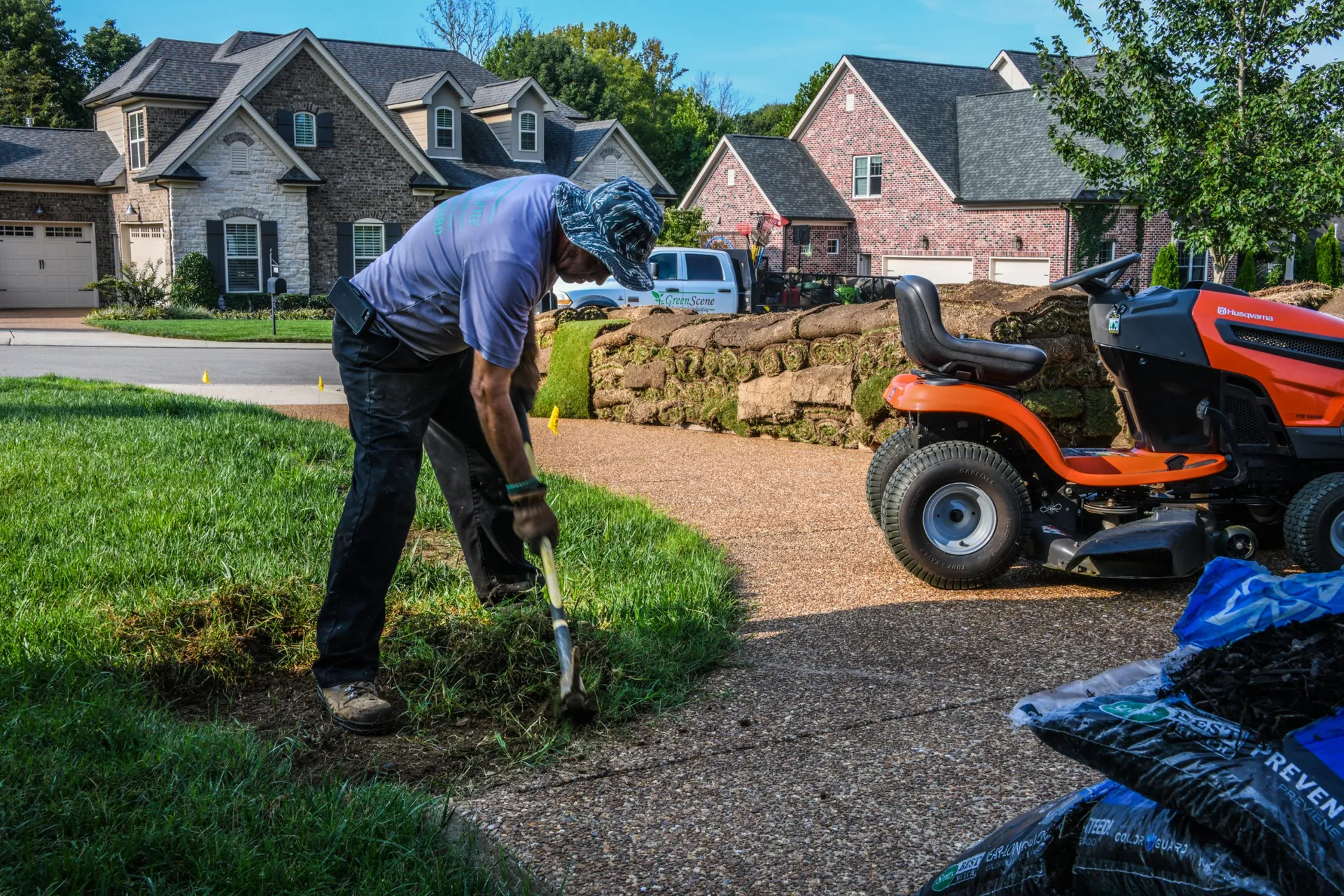
Lawn care at Green Scene is the program for the grass itself, laid out across the year. It covers the regular cut, aeration with a fertilization schedule, seed where the turf has thinned, new sod where it can't be saved, and a sprinkler system set for the variety. It suits Franklin-area homeowners who'd like one company to look at the whole lawn and decide what it needs, instead of buying one service at a time and hoping the pieces add up.
The first step is a free evaluation. Someone walks the lawn with you, names the grass, looks at the thin and bare areas, and tells you what it will take. If you aren't sure what to ask for, that's the visit to ask.
What does a lawn care program include?
Four kinds of work, each with its own page and its own season:
| Work | What it does | When |
|---|---|---|
| Mowing, trimming and edging | Holds the grass at the height its variety needs | Every scheduled visit in the growing season |
| Core aeration and fertilization | Opens packed soil and gets feed down to the roots | Fall for fescue; spring into summer for bermuda and zoysia |
| Overseeding | Thickens turf that has thinned out | Fall for fescue, early spring as the backup |
| Sod after Harley rake prep | Replaces a lawn that's too far gone | When repair won't catch up |
Few lawns need all four in the same year. The evaluation is where that gets sorted out.
Why does the type of grass change the plan?
Because the three lawns around here grow on opposite calendars. Tall fescue is a cool-season grass. Its big jobs, aeration and new seed, belong in the fall, and it has to be reseeded to stay thick. 419 Tifway bermuda and zoysia are warm-season grasses that grow through spring and summer, so their aeration lands in that stretch instead.
Put a fescue schedule on a zoysia yard, or the reverse, and you'll pay for work done at the wrong moment. The mowing height changes too: three inches on fescue, one to two on zoysia, a third of the blade at most on bermuda. Water is the last piece. A system that runs fescue too wet on hot summer nights invites brown patch, which is why the irrigation side of the business sets zones by grass as well.
Why does a lawn keep getting thin and weedy?
In Williamson County it usually comes back to one of four things:
- The soil. Clay packed down during construction, often with builder's sod laid right on top of it.
- The cut. Fescue mowed short dries out and opens up.
- The weather. Long freezes and summer droughts both leave thin and bare patches.
- The water. Too little and the grass browns; too much and fungus moves in.
Whatever the cause, thin turf doesn't stay empty for long. Grassy weeds and insects take the gaps. Chemical treatments can help hold them back, but the strongest defense a lawn has is grass growing thick enough to leave them no room.
When is sod the honest answer?
When the weeds have won, the ground is uneven and the bare spots outnumber the grass. Aeration and seed can rescue a lot of lawns, but not every one. At that point the crew brings in the Harley rake, a skid steer attachment that strips the old lawn, roots and rocks and levels the soil, and lays fresh fescue, 419 bermuda or zoysia sod from local farms in tight rows.
Who looks after the lawn?
The same family business that has been doing it in Franklin since it started with a push mower. Jose Garcia prices and plans the work, Teresa Garcia books the visits from the office on Mealer Street, and Antonio Estrada keeps you posted along the way.
I have had various landscapers provide services over the years, and Green Scene has been far and away the best. Our yard looks great.
Jeremy C., Franklin